

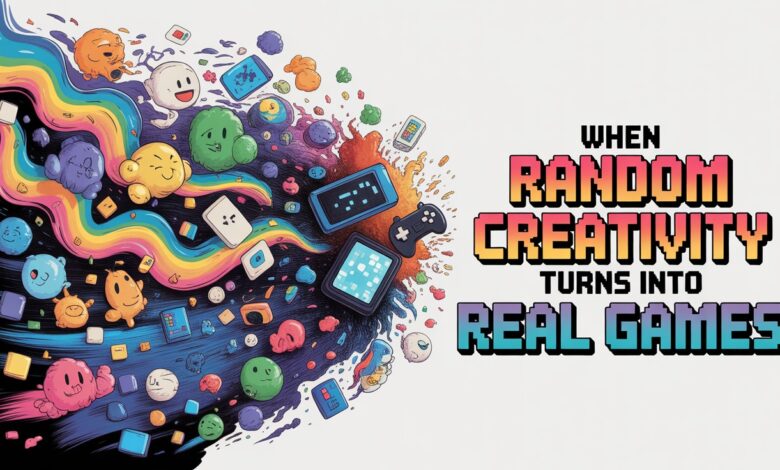
When random creativity gives rise to actual games, it means taking a concept from your imagination and making it something you can play. Like taking ideas, sketches, or silly concepts and turning them into something you can actually have fun with. These games don’t have to be complex; they just need a little creativity and some work to get them off the ground.
Have you ever had a fun challenge or wacky idea for a game, but weren’t sure how to implement it? That’s where all the magic is. Developing those chance ideas into real games can be both challenging and rewarding, and occasionally surprising.
Systems like Astrocade make it easy to bring your concepts to life. You can quickly create simple games, bringing your ideas from imagination to something you and your friends can play. You can lose hours of fun and creativity even with a small test.
Start With Ideas
Every game starts with a simple idea. It can be a laugh-out-loud funny setup, a challenge you couldn’t resist adapting, or a twist on a game you already love. Don’t overthink it, just let your imagination flow and write down anything you get. Sometimes one word, or just a single image, can give birth to an entire game idea.
Take inspiration from around you. Everyday events, small annoyances, or humorous instances can form the basis of games. You can also get together with friends and brainstorm or write down ideas in a notebook. The more ideas you have to work from, the better chance you have of finding one that really piques your interest.
Try New Things
When you have an idea, play with it. Don’t be afraid if it feels weird or uncomfortable. New things to try, tell you what ideas are fun, and which ones they ate the best. You get creativity when you start pushing the envelope, when you start going into different directions.
Combine rules and mechanics or game ideas, or add weird rules and see what happens – that can really mix things up. For example, a straightforward card game might become a strategy game if you introduce time constraints or team play. Trying out these variants early allows you to develop the most compelling iteration of your idea.
Build Simple Games
Begin making small, simple versions of your game. Use common materials like paper, cards, dice, or digital platforms to materialize your idea. You just need a rough prototype to understand how your idea works in reality. Don’t sweat perfection; a drawing or paper prototype can already illustrate the core mechanics.
Make fun, not complex. Basic builds enable you to test players’ interactions with your game and determine which rules actually work. For instance, if your goal is to build a game like Tankor Arena, you would begin with your core interactions and play that way to find out what is fun. You can add layers, such as scoring systems or challenges, after the basic game is fun to play. Small iterations make the process of creation more manageable and less scary, less like a permanent commitment, more like continual exploration.
Test Your Concepts
Once you have your prototype ready, it’s time to start testing. Play it yourself first, then have friends, family members, or co-workers give it a go. Feedback is how you find out what is working, what confuses players, and what actually makes the game more fun. Trials reveal surprises, things you never expected when you were designing the game.
Watch reactions and question players on every aspect of the game. Sometimes, small changes like altering a rule or slowing the pace can have a dramatic impact on fun. Playtesting also fosters adaptability, allowing you to witness how your creative mind is influenced by the practical application of play.
Make Fun Real
After testing and tweaking, your creativity at last is a playable reality. Celebrate the small victories, such as when a rule clicks or someone laughs at a clever moment. These milestones illustrate how ideas evolve from a concept into an experience.
Making fun real is about more than just the game. It’s the experience you provide and how much pleasure you give to people. Whether it is a small challenge or a more complex game, seeing the creativity turned into something playable is rewarding and satisfying. By sharing your game, you will let others play with your imagination and your work.
Conclusion
The process of turning disparate creative ideas into functioning games is an adventure in curiosity and trial and error. Starting from ideas, experimenting, making simple versions, and testing them, you can make dreams into something concrete and interesting. Even minor actions can bring about unexpectedly fun outcomes and even give you a sense of accomplishment.
And just remember, this isn’t about being perfect, it’s about playing, learning, and sharing joy. Each iteration of your design and modification of the rules brings you closer to a game like Oceanic Growth that actually works. With a bit of patience and ingenuity, those off-the-cuff ideas can turn into bona fide games that entertain, inspire, and connect people.
FAQs
How do I know if my idea can become a real game?
Start small and experiment. If people enjoy it and they’re engaged, it’s promising.
Do I need special tools to create a game?
Not at all. Paper, pencils, or basic software are sufficient for prototypes.
How long does it take for creativity to turn into a playable game?
It depends on the complexity of things. Some games can be made in a few hours, others require weeks of iteration.
What if my game doesn’t work at first?
Don’t worry. Testing and tweaking are all a part of the process. Every time you fail, you learn something worthwhile.
Can anyone turn their creative ideas into games?
Absolutely! Creativity is for everyone. It’s just a matter of patience and trial and error for anyone to make ideas happen.