


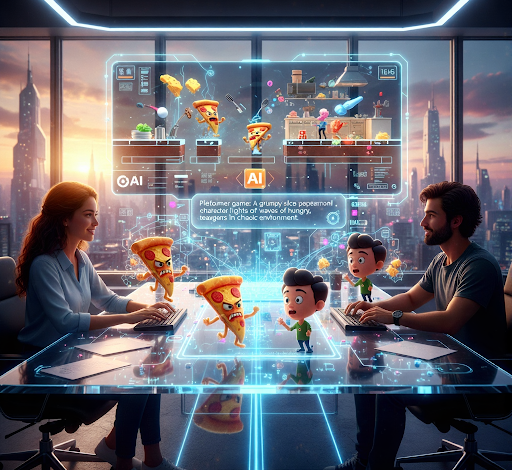
AI Turns Simple Prompts into Playable Games in Minutes
You have got a killer idea for a video game. Maybe it’s a platformer where you play as a slice of pizza fighting off hungry teenagers, or a strategy game about managing an ant colony on Mars. In the past, turning that idea into reality required years of coding knowledge, complex engines like Unity or Unreal, and a lot of patience.
Today, all you need is a sentence.
The landscape of game development is undergoing a seismic shift. Just as AI tools like Midjourney transformed art and ChatGPT revolutionized writing, a new wave of “prompt to playable” AI tools is breaking down the barriers to game design. With a simple text description, you can now generate code, assets, and game loops in minutes.
Whether you’re a seasoned developer looking to prototype faster or a complete beginner with a dream project, AI game makers are democratizing the industry. In this guide, we’ll explore how these tools work, the best platforms to try right now, and what this means for the future of interactive entertainment.
How AI Is Transforming Game Development from Prompts to Play
For decades, game development was an exclusive club. If you didn’t know C++, C#, or Python, your ideas remained just that, ideas. Even with the rise of “no-code” tools, the learning curve remained steep. The emergence of generative AI is changing the rules of engagement entirely.
What “Prompt to Playable” Means
The concept is straightforward: you type a natural language prompt (e.g., “Create a 2D side-scrolling shooter set in a cyberpunk city where the enemies are drones”), and the AI interprets this request to build a functional game. This isn’t just about generating a static image or a snippet of text; it’s about creating an interactive experience with rules, physics, and objectives.
The Role of Generative AI
Generative AI acts as the bridge between human creativity and machine logic. It understands the semantic meaning behind your request and translates it into the necessary components:
- Code Generation: Writing the scripts that make characters move and systems function.
- Asset Creation: Generating sprites, backgrounds, and sound effects on the fly.
- Logic Implementation: Setting up win/loss conditions and game loops.
Lowering Barriers for Non-Coders
The most significant impact of this technology is accessibility. You no longer need to understand syntax or debugging. If you can describe it, you can (mostly) build it. This shifts the focus from technical proficiency to creative vision.
From Years to Minutes
Traditional development cycles involve months of pre-production, coding, asset creation, and testing. AI compresses this timeline drastically. You can move from a “napkin sketch” idea to a playable web prototype in the time it takes to brew a cup of coffee. This speed allows for rapid experimentation, where failure is cheap and iteration is instant.
How Prompt-Based AI Game Creation Works
It might feel like magic, but under the hood, these AI tools are orchestrating a complex dance of Large Language Models (LLMs) and specialized generative networks. Here is the step-by-step process of how a text prompt becomes a playable game.
- The Prompt: Defining the Vision Everything starts with your input. The AI analyzes your prompt to extract key entities:
- Genre: Is it a platformer, a puzzle game, or an RPG?
- Mechanics: How does the player interact? (e.g., “jump,” “shoot,” “solve”)
- Theme/Aesthetics: What does the world look like? (e.g., “pixel art,” “vaporwave,” “medieval”)
The more specific your prompt, the better the output. For example, “A game about a cat” is vague, but “A physics-based puzzle game where a cat must knock vases off shelves without waking the dog” gives the AI a clear blueprint.
- Code and Logic Generation Once the AI understands what you want, it begins writing the underlying code. Most web-based AI game makers utilize Javascript or HTML5 frameworks (like Phaser.js). The LLM constructs the “Game Loop”—the heartbeat of any video game that processes input, updates the game state, and renders the graphics. It sets up collision detection (so you don’t fall through the floor) and variable tracking (like health or score).
- Asset Generation A game needs visuals and sound. Specialized AI models integrated into the tool generate these assets in real-time.
- Visuals: If you asked for a “space shooter,” the AI generates sprites for ships, asteroids, and lasers.
- Audio: It synthesizes background music and sound effects, like explosions or jump sounds.
- World Building: It arranges these assets into a level layout, placing platforms, enemies, and goals according to standard game design logic.
- Compilation and Deployment Finally, the tool compiles all these elements into a browser-compatible format. Within seconds, the code is executed, and a window pops up allowing you to play the game immediately. If something isn’t right, say, the jump is too floaty, you can simply tell the AI, “Make the jump gravity stronger,” and it rewrites the code instantly.
Popular AI Tools That Turn Prompts into Games
The market for AI game creation is exploding. While we are still in the early stages, several platforms are leading the charge, offering impressive capabilities for both novices and pros.
Astrocade
One of the most exciting platforms leading this revolution is Astrocade, the world’s first agentic AI game creation platform. This no-code tool lets anyone turn simple text prompts into fully playable games in minutes, with collaborative AI agents handling everything from mechanics and art to UI and audio. It’s perfect for rapid prototyping and community remixing, making it accessible for complete beginners while powerful enough for creative experimentation.
For example, check out community-created games like Cyber Table Hockey, a fast-paced, futuristic twist on air hockey or Dino Harvest Idle, an addictive idle game where you harvest resources with dinosaurs. These showcase how quickly ideas become interactive experiences.
Ludo.ai
Ludo.ai is a comprehensive suite for game design. It doesn’t just build the game; it helps you research and ideate.
- Playable Generator: You can define mechanics and themes, and Ludo uses “vibe coding” to assemble a prototype.
- Asset Generation: It includes dedicated generators for 3D assets, sprites, audio, and game concepts.
- Market Research: Uniquely, Ludo analyzes gaming trends to help you decide what to build, offering a “Ludo Score” to predict your game’s potential success.
Rosebud AI
Rosebud is making waves as a premier AI-powered game maker. It allows users to build 2D games just by chatting. You describe the game, play it, and then refine it through conversation. It gives you control over assets and even allows you to upload your own art styles. It’s particularly strong for RPGs and visual novels but is flexible enough for various genres.
Replit AI
While primarily a coding platform, Replit has integrated powerful AI that allows for prompt-to-app creation. You can ask Replit’s AI to “Code a snake game in Python” or “Build a breakout clone in Javascript,” and it will generate the code, install dependencies, and run the environment. It requires a bit more technical willingness than Astrocade or Ludo but offers immense freedom.
Emerging Platforms
- Google’s Genie: A research model (not yet fully public) that can turn a single image or text prompt into a playable 2D platformer, demonstrating the cutting edge of this tech.
Google’s Genie AI Model Creates Video Game-Like Interactive …
- YouTube Playables: There are rumors and experiments suggesting massive platforms may soon integrate simple game builders directly into social feeds, allowing creators to make mini-games for their audiences instantly.
Benefits of Using AI to Build Games in Minutes
Why should you care about prompt-to-playable technology? The benefits extend far beyond just “it’s cool.”
Rapid Prototyping and Validation
For professional indie devs, time is money. AI allows you to test a core mechanic in minutes. Instead of spending a week coding a prototype to see if a specific gameplay loop is fun, you can generate it, play it, and discard it if it doesn’t work—all before lunch.
Democratization of Creativity
There are millions of people with incredible game ideas who will never open a coding textbook. AI game makers like Astrocade unlock this latent creativity. Teachers can create educational games tailored to their specific lesson plans. Parents can build games with their children. Marketing teams can create branded mini-games for campaigns without hiring an external studio.
Customization and Personalization
Imagine a game that adapts to you. With AI, games can eventually be generated on the fly based on player preference. If you love stealth but hate combat, the AI could tweak the generated game to favor sneaking mechanics.
Faster Iteration for Students
For computer science students or game design majors, these tools are incredible learning aids. They allow students to reverse-engineer code. You can ask the AI to build a game, then look at the code it generated to understand how it works, effectively acting as a personalized tutor.
Limitations and the Future of Prompt to Game AI
While the technology is exciting, we must be realistic. We are not yet at the point where you can type “Make me the next Grand Theft Auto” and get a AAA blockbuster.
Current Limitations
- Depth and Complexity: Current AI tools excel at simple, arcade-style games. They struggle with complex narratives, deep RPG systems, or intricate 3D worlds.
- Coherence: Sometimes the AI “hallucinates” logic, creating bugs or impossible levels.
- Originality: Since AI is trained on existing data, the games can sometimes feel derivative or generic without significant human guidance.
The “AI Slop” Debate
There is a valid concern in the gaming community about a flood of low-quality, AI-generated content on platforms like Steam. The challenge for future developers will be using AI to enhance quality, not just quantity.
Future Trends
- Smarter Mechanics: Future models will understand game design theory better, creating more balanced and engaging difficulty curves.
- Multiplayer Support: We will soon see prompt-to-playable games that support instant multiplayer lobbies.
- Richer Worlds: As 3D generation improves, we will move from 2D sprites to fully realized 3D environments generated from text.
Conclusion
We are standing at the precipice of a new era in interactive media. AI game makers are transforming the “barrier to entry” into a “welcome mat.” While they won’t replace professional game developers anytime soon, they are a powerful new tool in the arsenal of creativity.
Whether you want to test a mechanic, build a fun distraction for friends, or just see your wildest ideas come to life on a screen, there has never been a better time to type a prompt and press play.
Start creating your own games today with Astrocade, no coding required, just your imagination.