

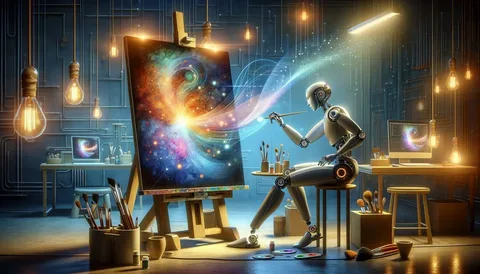
Visual communication has always evolved alongside technology. From traditional painting and photography to digital illustration and computer-generated graphics, each technological development has expanded the ways people can communicate ideas visually. Today, artificial intelligence is contributing to another major shift through AI Image Generation, allowing computers to produce increasingly sophisticated visual content from descriptions, concepts, and other forms of input.
This development is influencing creative industries, marketing, education, entertainment, and digital media. Rather than representing a single replacement for conventional design, generative artificial intelligence is becoming part of a broader ecosystem in which human creativity and computational tools work alongside one another.
From Digital Design to Generative Visuals
Digital design already transformed creative work by making editing, composition, and image manipulation faster and more flexible. Generative AI takes this development further by allowing systems to produce original visual compositions based on patterns learned from large collections of data.
Modern models can interpret relationships between words, objects, colours, environments, and artistic characteristics. As a result, a written concept can become the starting point for a visual composition without requiring every element to be manually constructed.
This has contributed to growing interest in technologies such as neuralpix, which are part of the expanding landscape of AI-assisted visual creation.
Understanding Text-to-Image Technology
One of the most recognisable applications of generative AI is Text-to-Image technology. It connects natural language with visual generation, allowing written descriptions to serve as the conceptual foundation for an image.
The process represents an important development in human-computer interaction. Instead of communicating with creative software exclusively through menus, drawing tools, or technical settings, users can increasingly describe ideas in ordinary language.
This approach has potential across many areas because language is already one of the primary ways people communicate concepts.
New Possibilities for Creative Professionals
Artificial intelligence does not eliminate the need for artistic judgement. Designers, illustrators, photographers, and creative directors still make decisions about composition, purpose, audience, style, and visual consistency.
AI can, however, provide additional possibilities during the development stage. Early concepts can be explored rapidly, alternative visual directions can be considered, and rough ideas can be transformed into visual references.
This can make experimentation less resource-intensive and allow creative professionals to spend more time evaluating ideas rather than producing every initial concept manually.
Applications Beyond Traditional Art
AI-generated imagery has applications far beyond conventional artistic projects. Businesses may use generated visuals when developing concepts for advertising, websites, presentations, or digital campaigns. Educators can explore customised illustrations for learning materials, while researchers may use visual generation to communicate abstract concepts.
The entertainment industry is another significant area of interest. Concept development for films, games, animation, and virtual environments can involve large numbers of visual references, making generative technologies potentially useful during early production stages.
The Rise of Creative Visuals
The concept of Creative Visuals is also changing as generative systems become more capable. Visual content no longer has to begin with an existing photograph, illustration, or physical object. An abstract idea can become the starting point for a completely new digital composition.
This encourages experimentation with unusual combinations of subjects, environments, colours, and artistic approaches. The result is a broader creative environment in which visual exploration can take place at a much faster pace.
Questions Around Authenticity and Responsibility
The growth of AI image generation also raises important questions. Copyright, authorship, transparency, originality, and the responsible use of generated content remain subjects of ongoing discussion.
These questions are particularly relevant for professional applications, where visual material may be used commercially or publicly. Understanding how an image was generated and what rights apply to its use is becoming an important part of modern digital creativity.
A New Stage of Visual Communication
AI Image Generation represents more than a new method of producing pictures. It demonstrates how artificial intelligence is changing the relationship between ideas and digital media.
As Text-to-Image systems continue to develop, their ability to interpret complex concepts and produce detailed visual content is likely to improve. At the same time, human judgement will remain essential for determining whether a generated image communicates the intended message.
The future of visual creativity will therefore likely involve a combination of human imagination and increasingly capable computational tools. Technologies associated with neuralpix, AI Image Generation, Text-to-Image, and Creative Visuals illustrate this transition toward a more flexible and interactive approach to digital content creation.