

Master the Simple Math: The Ultimate Guide on How to Convert Decimal to Percent Accurately and Quickly for Everyday Calculations and Success

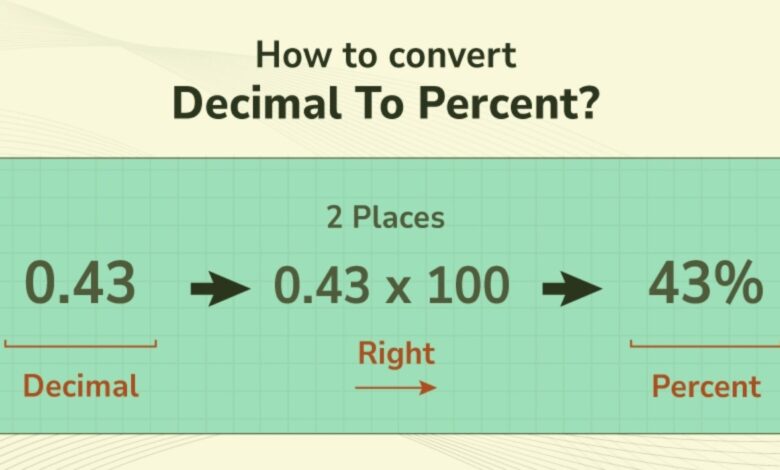
Understanding how to convert decimal to percent is a fundamental mathematical skill that appears in countless real-world scenarios, from calculating interest rates and analyzing data trends to understanding discounts while shopping. At its core, the process is straightforward, requiring only a basic understanding of base-ten numbering and multiplication. Whether you are a student preparing for an exam, a professional managing budgets, or someone simply looking to sharpen your mental math abilities, mastering this conversion will significantly enhance your numerical literacy and boost your confidence when dealing with everyday statistics, financial figures, and complex data representations in any environment.
| Feature | Details |
| Primary Goal | Convert decimal to percent effectively |
| Basic Formula | Decimal×100=Percent |
| Quick Trick | Move the decimal point two places right |
| Common Use | Finance, statistics, and discounts |
| Key Symbol | % (per centum) |
The Mathematical Foundation of Percentages
To convert decimal to percent, you must first grasp what a percentage actually represents. The word “percent” literally means “per hundred” or “for every hundred.” A decimal, on the other hand, represents a fraction of a whole based on powers of ten. When you transition from one to the other, you are simply changing the unit of measure to make the number more intuitive for human comparison. Recognizing this relationship allows you to see numbers not just as abstract values, but as portions of a whole, which is a critical skill for interpreting the vast amount of data we encounter daily.
Understanding the Standard Conversion Formula
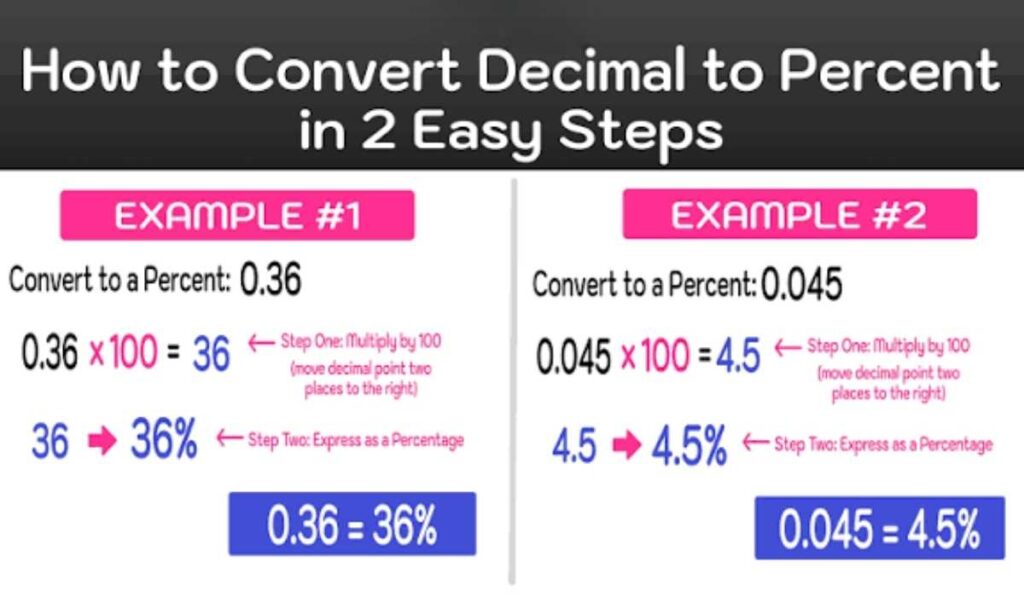
The most reliable way to convert decimal to percent is to use a simple multiplication formula. You take any given decimal value and multiply it by 100. For example, if you have the decimal 0.75, performing the calculation 0.75×100 gives you 75. Once you have the numerical result, you simply attach the percentage sign (%) to the end to express it correctly. This method works universally for every type of decimal, whether it is a terminating decimal, a simple fraction equivalent, or a long, complex value, providing a consistent way to reach the right answer every time.
The Shortcut: Shifting the Decimal Point
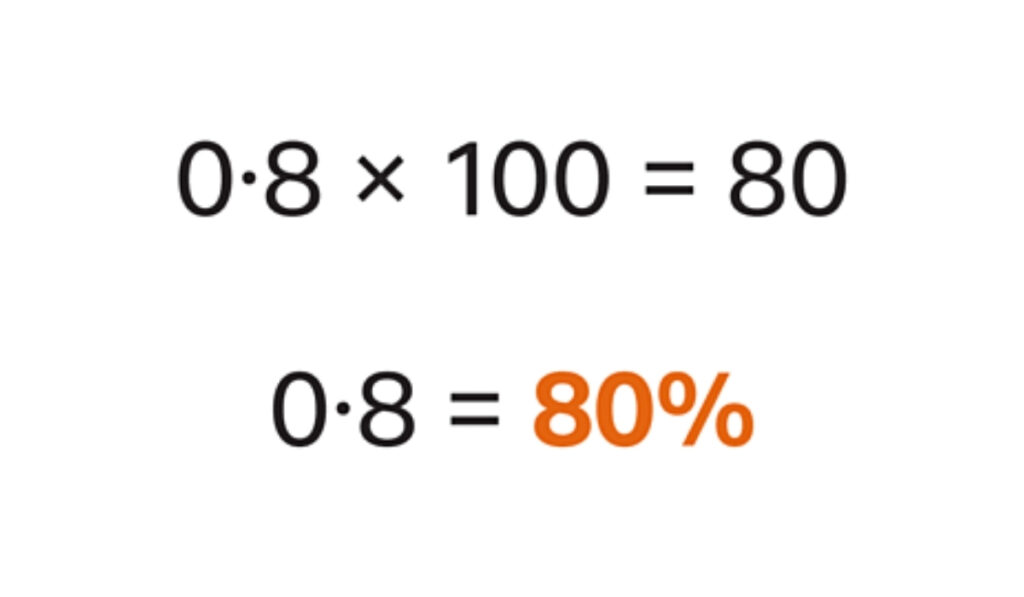
If you want to convert decimal to percent without using a calculator, the “two-place shift” trick is your best friend. To do this, locate the decimal point in your number and move it two positions to the right. If the number does not have enough digits to move the point, simply add zeros to the end until the shift is complete. For example, the decimal 0.5 becomes 50 when the point moves two places, resulting in 50%. This mental math shortcut is incredibly efficient, allowing you to perform quick conversions on the fly during meetings, shopping, or schoolwork.
Why We Use Percentages Instead of Decimals
We choose to convert decimal to percent because percentages are generally easier for the brain to visualize and compare. Saying “a 25% increase” is much more impactful and easier to understand than saying “a 0.25 increase.” Percentages provide a common language for expressing ratios, probabilities, and changes in size. This standardized format is the reason why banks, retailers, and scientists all rely on percentages to convey information. By converting, you bridge the gap between pure raw data and actionable human insight, making it possible for others to grasp the significance of your findings almost instantly.
Dealing with Values Greater Than One
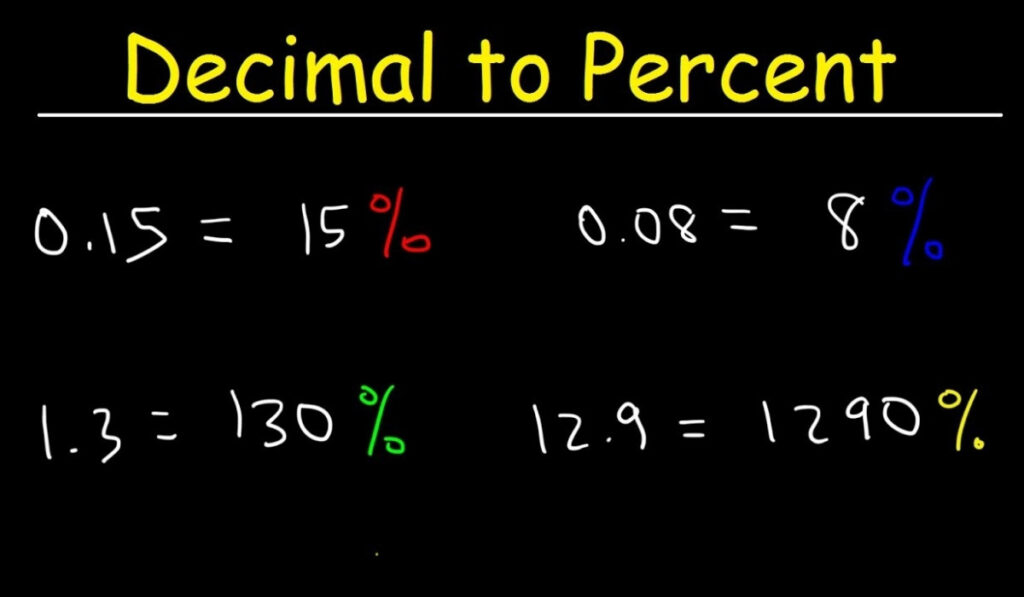
When you convert decimal to percent for numbers greater than one, the result will always be greater than 100%. This often confuses beginners, but it is entirely logical. A value of 1.0 is equal to 100%, so a value of 2.5 represents 250%. This frequently occurs in finance when calculating growth rates, interest, or productivity improvements. Remembering that 1.0 is the baseline for 100% keeps your mental framework aligned. Whether you are dealing with 0.01 or 10.0, the rule remains the same: multiply by 100 and append the percent sign to achieve the correct representation.
Handling Tiny Decimal Values
Often, you will need to convert decimal to percent for very small numbers, such as 0.0025. Applying the two-place shift rule here is vital. Moving the decimal two places to the right gives you 0.25%. This is common in scientific fields, tax calculations, or interest rates where precision is paramount. Never assume that a small decimal will not become a meaningful percentage. Even values like 0.0001 result in 0.01%, which can be significant in certain contexts. Accuracy in these small-scale conversions is just as important as it is for larger numbers, so always double-check your decimal point placement.
Converting Fractions to Decimals Before Percentages
Sometimes, you start with a fraction rather than a decimal, which makes it harder to convert decimal to percent. In these cases, first perform the division (numerator divided by denominator) to find the decimal equivalent. For example, 1/4 becomes 0.25. Once you have that decimal, apply your standard conversion rules to get 25%. This multi-step process ensures you reach the correct percentage without guessing. By mastering fraction-to-decimal division first, you expand your overall math toolkit, allowing you to handle a wider variety of inputs that you might encounter in professional or academic settings.
Common Pitfalls to Avoid During Conversion
The most frequent error people make when they convert decimal to percent is forgetting the decimal point shift or miscounting the positions. Another issue is confusion regarding the placement of the percent sign. Remember, the percent sign is not a decimal point; it is a label for the value multiplied by 100. Always write your work down if you are dealing with complex numbers to avoid these simple errors. Taking that extra moment to verify your shift ensures you don’t end up with values that are ten times larger or smaller than they should be, maintaining the integrity of your calculations.
Practical Examples in Daily Life
To see why we convert decimal to percent, look at your credit card statement or a sale advertisement. A discount of 0.3 off the original price is clearly communicated as 30% off. Understanding this allows you to calculate savings instantly in your head. If an item costs $50 and the discount is 0.3, multiplying 50×0.3 gives you the discount amount of $15. This skill saves you money and time. Practicing this in real-world scenarios makes the math feel less like a school chore and more like a helpful tool for navigating your financial life effectively.
Using Technology for Complex Conversions
While manual calculation is a great skill, you can use technology to convert decimal to percent when precision is required for large datasets. Excel, Google Sheets, and financial calculators all have built-in functions to format cells as percentages automatically. In Excel, for example, changing a cell’s format to “Percent” automatically multiplies the underlying decimal by 100 and adds the sign for you. Knowing how to use these digital tools is essential in modern professional environments, where efficiency and accuracy with large volumes of data are highly valued. Always leverage technology when the scale of the task demands it.
The Role of Percentages in Statistics
Statistics rely heavily on the ability to convert decimal to percent to explain probability and data distributions. Whether you are looking at poll results, weather forecasts, or demographic trends, data is usually presented as a percentage to make it digestible. If a poll indicates that 0.62 of respondents prefer a candidate, stating this as 62% makes the data much easier to process for the audience. Mastery of this conversion allows you to communicate complex findings to stakeholders clearly, ensuring that your data-driven arguments are persuasive and easy to follow, regardless of the complexity of the original findings.
Practice Exercises for Skill Retention
The only way to truly master the ability to convert decimal to percent is through consistent practice. Create a list of random decimals, such as 0.12,0.99,1.5,0.005, and 0.8, and challenge yourself to convert them mentally. Check your answers using the 100× formula. Doing this for just five minutes a day will build “math muscle memory,” making these calculations instantaneous for you in the future. As you get faster, try harder numbers or combine them with real-world problems. The more comfortable you are, the less likely you are to make mistakes during high-pressure situations.
Understanding Reciprocals and Percentages
Sometimes, you might need to understand the relationship between a number and its inverse when you convert decimal to percent. While this is an advanced concept, knowing that 0.5 is 50% and its inverse 2.0 is 200% can help you verify your work. This level of understanding provides a safety net; if you perform a calculation and get a number that feels “wrong,” your intuition will flag it. Advanced mathematical awareness helps you spot errors before they become problems, especially in fields like finance, engineering, or research where even a small error in percentage representation can lead to significant consequences.
Explaining the Concept to Others
Teaching is a great way to reinforce your own ability to convert decimal to percent. Try explaining the two-place shift rule to a friend, child, or colleague. When you articulate the logic behind moving the point, you solidify the concept in your own mind. If you can explain it simply, you understand it deeply. This is a valuable skill in a workplace, where you may often need to walk others through your calculations. Being the person who can clear up numerical confusion is an asset, making you a more effective communicator and a highly respected team player.
The Significance of Precision in Science
In scientific applications, the need to convert decimal to percent requires absolute precision. A small error in a percentage calculation could mean the difference between a successful experiment and a failed one. Scientists often use calculators that maintain high decimal precision, and the final conversion is done only at the very end to prevent rounding errors. If you are working in a technical or scientific field, always keep your decimals in high-precision mode until you are ready to present the final percentage. This discipline is essential for ensuring that your results are scientifically valid and reproducible.
Cultural and Global Variations
While the method to convert decimal to percent is universal, it is helpful to note that different cultures may use different separators for decimals—some use a period, while others use a comma. If you are working in a global team, always check the local number formatting standards. Despite these formatting differences, the underlying math—the multiplication by 100—remains exactly the same globally. Being aware of these minor technical variations is a hallmark of professional mathematical practice, ensuring that your data remains clear, accurate, and perfectly understood by colleagues and clients, no matter where they are located in the world.
Historical Context of Percentages
The concept of using a base-hundred system to convert decimal to percent dates back to ancient times, originally stemming from tax and commerce calculations in Rome. The idea of “per centum” was a standardized way for merchants to compare rates of interest or discounts regardless of the specific currency. Understanding this history adds a layer of depth to your mathematical practice, showing that the need to simplify data is a timeless human requirement. We are still using the same logic developed thousands of years ago to handle our modern digital economy, which is a testament to the utility of this simple mathematical tool.
Integrating Percentages into Financial Literacy
Financial literacy is almost impossible without the ability to convert decimal to percent. Interest rates, investment returns, tax rates, and inflation are all expressed as percentages. When you see an investment offering a 0.07 return, you need to quickly know that this is 7%. This allows you to compare different financial products on an even playing field. Taking control of your personal finances starts with understanding these numbers. If you cannot convert them, you are leaving your financial decision-making to chance rather than making informed choices based on clear, standardized data representations.
The Future of Numerical Data Representation
As we move into an era dominated by big data and machine learning, the ability to convert decimal to percent remains as relevant as ever. Computers process data in binary and decimal formats, but humans still require percentages to understand the outputs of these complex systems. Whether you are looking at algorithm accuracy, market growth rates, or resource allocation, the need for human-readable percentages is not going away. By mastering this simple conversion now, you ensure that you remain a capable and confident user of data in an increasingly complex and numerical digital future that we all participate in today.
Summary: Mastering the Art of Conversion
To conclude, the journey to convert decimal to percent is one of the most useful paths in applied mathematics. It is a tool of clarity that turns raw data into meaningful information. Whether you are using it to solve a complex statistical equation, calculate a simple discount, or manage your personal budget, the process is always grounded in the simple principle of moving the decimal point or multiplying by one hundred. By embracing this skill and practicing it until it becomes second nature, you take a significant step toward achieving numerical fluency that will serve you throughout your entire life. For more mathematical history.
- What is the easiest way to convert a decimal to a percent?
- Simply multiply the decimal by 100, or move the decimal point two places to the right.
- Does the percentage sign change the value?
- No, the percentage sign is just a way of labeling the number after you have multiplied it by 100.
- How do I convert 0.005 to a percent?
- Moving the decimal two places to the right gives you 0.5%.
- Why do we use percentages instead of just decimals?
- Percentages are easier for humans to visualize and compare, especially in statistics and finance.
- What if the decimal is larger than 1?
- If the decimal is larger than 1, the resulting percentage will be larger than 100%.