

Luxury watches represent one of the few categories where physical objects reliably hold and appreciate in value over decades. A well-maintained timepiece purchased today can command significantly more at auction twenty years from now, provided it has been treated with appropriate care throughout its life. Storage is not a peripheral concern for serious collectors. It is a direct determinant of long-term value. The decisions you make about where and how your watches live between wearings affect their mechanical condition, their aesthetic presentation, and ultimately their worth to future buyers. Understanding what investment-grade storage actually requires is the first step toward protecting what you have already acquired.
The True Cost of Inadequate Watch Storage
Preventable damage is the most expensive category of watch ownership cost because it compounds quietly over time. A scratch acquired in a drawer does not announce itself. It accumulates alongside other minor damage until the collective effect becomes visible and measurable in resale discussions.
Moisture damage presents a more serious threat than most collectors appreciate until they encounter it directly. Gasket degradation, dial spotting, and movement corrosion all trace back to humidity exposure that proper storage would have prevented entirely. Professional restoration of moisture-related damage is expensive, time-consuming, and sometimes incomplete regardless of the quality of the watchmaker involved.
Magnetic interference from everyday household electronics affects mechanical accuracy in ways that are invisible until a watch begins running noticeably fast or slow. Demagnetization requires professional service and represents a cost that proper storage placement eliminates completely. Collectors who position watches near computers, wireless chargers, or audio equipment are accepting a risk that serves no purpose.
What Makes Storage Investment-Grade
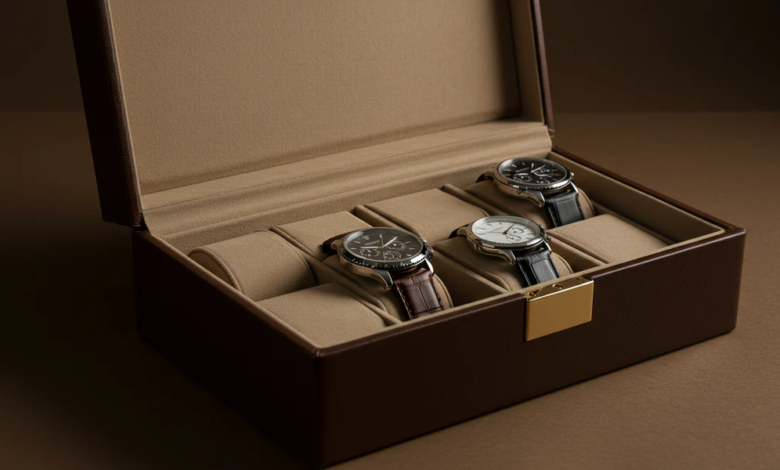
Investment-grade storage is designed to address real risks rather than simply provide space. Material quality forms the foundation, something any experienced jewelry box manufacturer prioritizes through durable construction and protective interiors. Solid hardwood resists warping across environmental changes, while anti-tarnish linings protect metal finishes.
Climate control separates basic storage from true protection. Solutions that maintain 40 to 60 percent relative humidity help preserve gasket integrity and lubricant performance, preventing both corrosion and drying over time.
Security features scale with collection value. Precision locks protect against unauthorized access and signal responsible ownership to insurers, which can influence coverage and premiums.
Different Storage Needs for Different Watch Types
Automatic watches present a specific storage consideration that manual and quartz pieces do not share. When left unworn for extended periods, automatic movements allow lubricants to settle and potentially thicken, which accelerates wear during the next period of active use. Watch winders address this by maintaining movement while the watch is not being worn.
Vintage pieces require particular attention to material compatibility. Some interior lining materials used in lower-quality storage products off-gas chemicals that react with aged lacquers, patinated dials, and original leather components. Collectors who own pieces with original tropical dials or other condition-sensitive surfaces need to verify that their storage materials are chemically inert.
Sports watches and dress watches often benefit from separate storage approaches despite belonging to the same collection. Robust sports pieces can tolerate more accessible storage arrangements, while delicate dress watches with vulnerable dials and cases deserve more protective individual compartments within any storage system.
Building a Storage System That Grows With You
Planning for collection growth at the outset of a storage investment prevents the disruptive and costly process of rebuilding your system every time you acquire significant new pieces. Modular storage approaches allow expansion without requiring complete reorganization of existing storage arrangements.
Consolidation versus distribution is a strategic decision that depends on collection size, home layout, and security considerations. Some collectors prefer keeping everything in a single dedicated location that can be secured comprehensively. Others distribute storage across multiple locations to reduce the impact of any single security event. Neither approach is universally superior, but both require deliberate planning rather than organic accumulation.
Travel storage deserves separate consideration for collectors who wear their watches away from home regularly. Purpose-built travel cases with rigid exteriors and individually cushioned compartments provide meaningful protection during transit. Improvised travel solutions, regardless of how convenient they seem, consistently produce the kind of contact damage that undermines years of careful storage at home.
The Annaigee Approach to Watch Protection
Annaigee has built its reputation on understanding that serious collectors require storage solutions engineered to the same standard as the watches they protect. Every product in their range reflects a commitment to materials and construction that address real preservation requirements rather than simply providing an attractive container.
Working with a dedicated watch box manufacturer like Annaigee means accessing customization options that generic storage products cannot offer. Individual compartment configurations, exterior finish selections, and interior material choices allow collectors to build storage systems that match both their collection’s specific needs and their personal aesthetic preferences.
Annaigee’s experience also extends across the broader packaging market. As a respected jewelry box manufacturer, they bring material expertise and quality standards developed across multiple product categories to every storage solution they produce. That breadth of experience translates directly into products that perform reliably over the long periods that serious collectors demand.
Conclusion
Investment-grade watch storage is not a luxury addition to a serious collection. It is a fundamental requirement for anyone who intends to maintain the value and condition of what they have acquired over time. The cost of proper storage is modest relative to the value it protects and the damage it prevents. Evaluate your current storage against the genuine threats your collection faces rather than against the convenience it provides. The watches you own today represent decisions made with care and deliberate intent. They deserve storage solutions built to the same standard, maintained with the same seriousness, and chosen with the same attention to quality that guided every acquisition in your collection.